
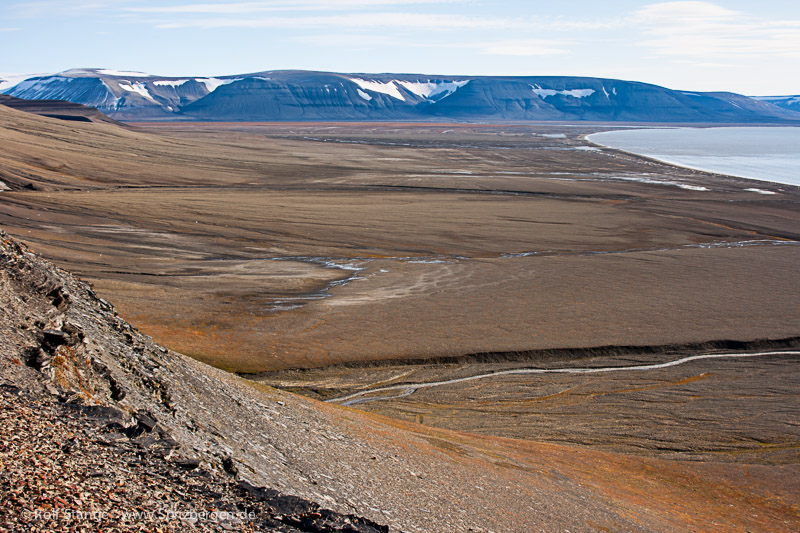
In May 1743, a Russian vessel carrying fourteen men became trapped in ice near Edgeøya (pronounced Ed-goy-ah), off the south-eastern coast of Spitsbergen. They were, senior officer Aleksei Inkov, and crew members Khrisanf Inkov, Stepan Sharapov, and Fedor Verigin.
Fearing the ship could be crushed, four men crossed two miles of moving ice to find a hunters' hut that Aleksei Inkov had heard about. In the event of the ship's situation worsening, it was thought that they could winter there.
They took one gun, twelve rounds, an axe, knife, kettle, some flour, a tinderbox, tobacco and their pipes.
When they returned to the shore the next morning, the ship was gone. In disbelief and 'with heavy hearts' they returned to the hut. They spent the rest of their time on Edgeøya not knowing if they had been abandoned or if their crew mates were lost. The ship was never heard of again.
Tools for Survival
The men must have been experienced hunters. Their twelve shots killed twelve reindeer. After that, they had to build the tools for survival.
When the ammunition ran out, they made a bow from a fir tree root washed ashore, using polar bear sinew for the string. Driftwood became arrows and wreckage provided iron for the tips and spears.
With no proper tools, they turned an iron hook into a hammer and used a large stone as an anvil. They used clay to make a lamp fuelled by reindeer fat and kept it burning continuously, knowing that if the fire went out, damp driftwood might make it impossible to relight. I imagine also that this provided them with focus and maybe prevented some despair.
When rope for the wicks ran out, they burned strips of their clothing and replaced their clothes with reindeer and fox skins, sewn with sinew and a needle they made from iron.
During the long winters, it would have been completely dark for four months and even after that, a blue twilight for two months. Snow buried the hut so they mate a hatch to climb out through the roof.
Without a clock, they improvised, using a shadow stick, their basic knowledge of the stars and religious feast days to keep track of time.
They ate raw frozen meat to begin with, until they figured that the ceiling of their chimneyless hut, could be used as a smoker for the meat. Although the cause of scurvy was not known at the time, they ate Arctic grass, which later became known as scurvy grass for its high vitamin C content. They also drank the warm blood of the animals they killed which provided vital nutrients.
The Final Days
They hunted, repaired the hut, prepared skins, made clothes and tools and kept the fire alive. During Fedor Verigin's final year, when he became too weak, the three men nursed him.
The frozen ground made burial impossible, so the others buried him deep in the snow and covered his body to protect it from polar bears. A poignent extract from Pierre-Louis Le Roy's interview with the survivors in 1751 revealed that each man lived with the fear that he might outlive the others and eventually be left alone.
In August 1749, whilst going about their gruelling daily duties, they spotted a ship.
They lit fires and raised a flag made from reindeer hide. It was a Russian merchant vessel, heading for West Spitsbergen that had been blown off course. The Captain lowered a boat and sent crew members to meet them who were astonished to find wild looking men dressed in polar bear skins, speaking Russian.
Negotiating Passage
They had to negotiate their passage home which sounds harsh, but for the captain to abandon his original mission and bring them home would have been costly. A deal was done there and then on the beach.
They agreed to pay eighty rubles, the equivalent of several years’ pay. In addition, they agreed to work aboard the ship and give up all their possessions, including hides, reindeer fat and the tools they had made. Among them was their handmade needle, kept in a small box they had carved from bone.
They reached Archangel on 28 September 1749. Six years and three months after they had left.
When the skins were sold, they made 200 rubles so the Captain was paid off in full and each of the men were left with 40 rubles each, enough to restart their lives.
The calendar they kept was only a few days out.
Edgeøya (Song Lyrics by Imelda Kehoe)
None of us want to be the last man here.
Or to see our numbers lessen.
To starve or be killed.
To die from the cold.
On Ed-goy-ah
All of us, fight for our lives.
Our fate in the wreckage.
We hunt and be hunted.
We count the days.
On Ed-goy-ah
photo credit: https://www.spitsbergen-svalbard.com/photos-panoramas-videos-and-webcams/spitsbergen-photos/photos-edgeoya.html