
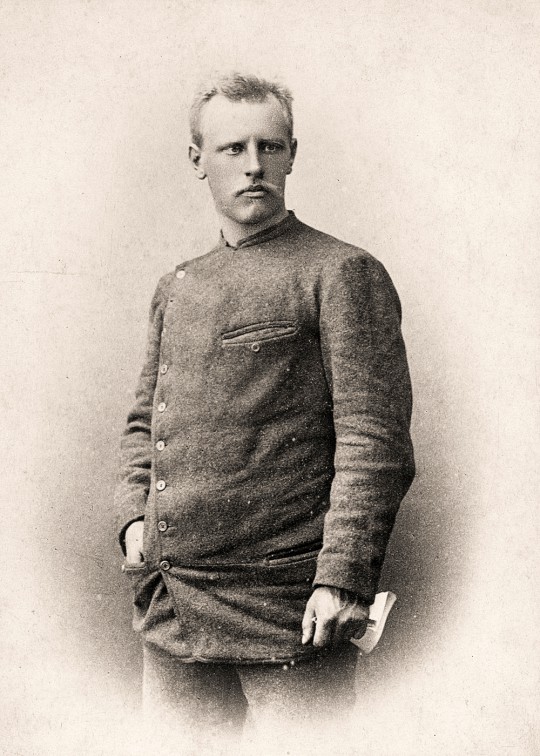
By the age of 27, Norwegian, Fridtjof Nansen was already an accomplished explorer and Doctor of Zoology.
In 1888 he led the first crossing of Greenland and was a National hero in Norway.
Nansen had three leadership qualities that set him apart:
The first was his character: He was intelligent, visionary, energetic and confident but he was also modest. He led by example. People trusted him.
Secondly, he actively sought to learn from Sami and Inuit people. He brought their survival methods into his own expeditions.
The third quality was his attention to detail. He was a meticulous planner.
Nansen was fascinated by the evidence that Siberian driftwood was washed up on Greenland.
He believed that it was transported by the polar ice cap. That the Ice drifted.
He came up with a radical idea.
He would deliberately sail a ship north of Siberia and get frozen in.
The ice would carry them across the Arctic like the Siberian driftwood.
Whilst he was there it would become a drifting research centre.
It was widely criticised as reckless.
But if Nansen was right, Norway could claim one of the most significant geographical scientific discoveries of the Age.
It would prove the theory of Arctic Drift.
So the Norwegian government and King Oscar funded it.
Nansen commissioned a special ship which he named, Fram, meaning Forward.
The most distinctive feature was her rounded hull, designed so that, instead of being crushed between converging ice, she would rise upwards.
More than a thousand men applied to join the expedition. Nansen selected just twelve, two of whom had crossed Greenland with him.
One of these was Otto Sverdrup, an extremely accomplished explorer and Captain in his own right.
He became second in command.
They left Norway in June 1893,
By late September they were locked in ice.
They locked in ice above the New Siberian Islands,
79 degrees north.
Life aboard the Fram was surprisingly comfortable. Food was varied and plentiful. Birthdays and feast days were celebrated.
There were books, musical instruments and a workshop.
The men were so healthy and content that the ship’s doctor had little to do and he took on other duties.
They had brought 35 Siberian sledge dogs. They were powerful but difficult to handle. It took a lot of time and effort.
Early attempts at sledging on the ice were chaotic but they got better and eventually mastered it.
Polar bears prowled around the ship and on one occasion a bear came aboard and killed two dogs.
There was danger from the Ice too.
At times the ice pressed against the Fram with such force that the men feared she would be crushed, but she always performed exactly as planned and gradually rose up.
The wind had a bigger contribution to their progress than was foreseen. It could accelerate, slow or even reverse their longitude and latitude position.
Nansen observed how the announcement of their position could affect the men's morale and determine the mood of the day.
As they entered their second winter, he was confident that his theory of the Arctic drift had been proven.
But something troubled him.
They appeared to be drifting around the North Pole rather than across it.
So he made a decision to attempt to reach the North Pole on foot and Otto Sverdrup took command of the Fram.
Several men volunteered to accompany him. Nansen chose Yalmar Yohansen for his physical strength and character.
Let’s just recap for a minute:
They are a year and a half into the expedition.
They have spent two winters locked in drifting ice.
They have 2 years of supplies left.
They have already proven the theory of Arctic Drift and captured new discoveries about the Arctic Ocean.
They are further North than any human has ever been.
But they are still 600km from the North Pole.
And now, Nansen and Johansen were about to embark on one of the most incredible stories of Arctic Survival.
LEAVING THE FRAM
They left in March with three sledges, two kayaks, 28 dogs and provisions for 100days.
Occasionally, they found stretches of level ice.
But more often, their path was blocked by pressure ridges forcing them to manually haul everything over and reload on the other side.
After around a month of extreme effort, they had reached 86 degrees north.
But their supplies were dwindling, the terrain was becoming increasingly difficult, and Nansen knew that continuing north could cost them their lives.
He made the decision to turn south for
Franz Josef Land.
And now they faced the long and difficult journey south.
After one particularly exhausting day, something happened that would affect them greatly.
Both men had allowed their watches, which kept Greenwich Mean Time, to run down.
They could calculate their local time using stars but without knowing Greenwich time, they couldn’t determine how far east or west they were.
As they travelled south, the ice became increasingly broken and forced long detours.
Nansen had set out knowing that their dog team would gradually diminish. (I won’t go into those details here because some people might find it upsetting).
Let’s just say that by the time they reached open water.
None of the 28 dogs remained.
When they finally reached open water, they charted a course based part on calculations, part on instinct
They lashed their kayaks together, secured the remaining equipment and began making their way through the channels of open water.
When they finally saw islands, they didn’t correspond with their maps.
For weeks they travelled down a coastline they could not identify.
Nansen charted these as they went along.
As it turned out, they were among previously uncharted islands at the very top of Franz Josef land.
By late August, the weather was deteriorating. Winter was approaching, and they were still far from safety.
They had no choice but to build a shelter and stay there for the Winter.
THE SHELTER
They spent the next few weeks hunting walrus and polar bear to gather blubber, meat and hides.
They made tools from their remaining equipment.
They made a pick from a sledge runner and a spade from a walrus shoulder blade.
They didn’t have materials to build a hut so they dug a pit in the shale beneath a cliff. It was 10ft long x 6ft wide and around 3 or 4ft deep.
Around the top of it they built a stone wall 3ft high.
They found driftwood for the roof and covered it with walrus hide.
Getting the walrus hide was an ordeal in itself.
An adult walrus can weigh well over a tonne, so they had to tow them through the water then butcher them in the freezing water on the beach, timing it with the ebb and flow of the tide so they could turn the carcass over.
It took several days and Nansen described this as among the worst work of the entire expedition.
They made a J shaped tunnel entrance into their shelter so they had to crouch down to get in. This provided some weather protection and it was easier to block it off to bears.
They made lamps and constructed a small hearth for cooking and lay polar bear hides on the ground as a sleeping area.
As winter progressed, their existence was reduced to cooking, eating, sleeping and venturing outside for ice, meat or blubber or to exercise to try and get warmth into their limbs.
Their clothing became saturated with grease from the hides that they used as clothing. These froze to their skin, leaving painful sores.
The blubber that they burned gave off black smoke and they were covered in black greasy soot.
They slept together in a bearskin sleeping bag, on hides that eventually began to rot.
Polar Bears were a threat they would come and investigate the hides and blubber stocks.
They killed a few more this way.
One animal became surprisingly irksome to them.
Arctic Foxes would come and steal their food and their things. The men found a fox’s layer and their thermometer was in it. They took it back but the Fox stole it again and they didn’t get it back.
During the winter, when the lamps were burning they could get the temperature in the centre of their shelter to around freezing point but hoarfrost covered the walls that they slept beside.
They had no books and Nansen said that he missed that terribly.
At Christmas, they brought out provisions they had carefully saved.
They attempted to wash themselves with half a cup of warm water to somehow mark the occasion.
By January, temperatures outside had fallen below minus 40.
They endured. They slept. And gradually light returned.
As spring approached, the hut became what Nansen called a tailor’s and shoemaker's workshop.
They repaired their battered clothing and equipment as best they could.
In May, they finally set out again, hauling their kayaks across the ice and paddling whenever they reached open water.
But the dangers were far from over.
On one occasion, their kayaks drifted away and Nansen swam after them, he barely survived it.
On another occasion, a walrus attacked his kayak, tearing a hole through it and wounding him.
They continued south, uncertain of their exact position.
Then, something extraordinary happened
Whilst preparing breakfast, Nansen thought he heard something.
He stopped and listened.
It was a dog barking.
Then he heard a human voice and Nansen called out.
And the human answered.
It was Frederick George Jackson, leader of a British expedition based at Cape Flora on Northbrook Island.
Jackson was clean-shaven, neatly dressed in a checked suit and rubber boots.
Nansen’s clothes were in rags, his hair and beard were long, and his face was blackened with grease and soot.
Jackson greeted the stranger politely.
He asked whether Nansen had a ship nearby.
Nansen said No.
He asked how many men?
Nansen said, just one waiting at the ice edge.
Jackson said he would immediately send men to fetch him, and they began walking towards the camp.
Then Jackson stopped. He looked more closely at the man beside him.
"Are you Nansen?"
"Yes, I am."
Jackson shook his hand again. A lot more enthusiastically this time.
"By Jove, I am glad to see you!"
At Cape Flora there was soap, hot water, clean clothing, books and proper food.
Remarkably, Jackson carried letters for Nansen from home.
In case their paths might cross.
Nansen describes his heart pounding and hands trembling as he opened letters from his wife, Eva and learning that she and his daughter Liv were safe and well.
But there was still one uncertainty.
The Fram.
They spent a few weeks at the camp while they waited for a supply ship.
They finally arrived in Vardo on Norway’s northern coast in August 17months after leaving the Fram.
They were so keen to get to the shore that before their ship had even anchored, Nansen and Johansen were already in a boat heading to the telegraph office.
He placed a large bundle of telegrams on the counter and asked for them to be sent immediately.
The official was terse and told him that it would take several days. (in other words, who do you think you are?)
He agreed to send the first ones now, the rest would have to wait.
Then he saw the signature on the first telegram to Eva.
And he was shocked to see the man everyone had presumed dead, standing before him.
The next telegram was sent to Johansen’s mother, then the families of the other men on the Fram. After that, the King and then the Norwegian government.
News travelled fast.
In an extraordinary coincidence, on the very day Nansen arrived at Vardø, the Fram finally broke free from the Arctic ice north of Svalbard and she arrived in Skjærvøy on Norway's northern coast a week later.
Otto Sverdrup went ashore to the tiny telegraph office.
But everyone was asleep.
He hammered on the doors, trying, as he later put it, to "knock life into the people."
Eventually, at about half past four in the morning, the sleepy operator appeared at an upstairs window, demanding to know who was making such a racket.
Sverdrup called back:
"I come from the Fram."
The operator immediately came downstairs and let him in full of apologies.
He gave him the news that Nansen and Johansen were alive and as soon as Sverdrup had delivered his telegrams he rushed back to the ship to tell the others and of course they were overjoyed.
That morning, Nansen received a telegram personally delivered by the head of the telegraph office.
Mr Nansen, I think this will be of interest to you.
He opened it with trembling hands.
It was from Otto Sverdrup.
“Fram arrived in good condition STOP All well on board STOP. WELCOME HOME.”
Nansen, Johansen and the crew of the Fram were reunited in Tromsø in August 1896 and they were received in Oslo to a hero’s welcome.
Nansen went on to become a famous scientist, diplomat and humanitarian. He was awarded the Nobel Peace Prize in 1922 for his humanitarian work.
Otto Sverdrup took the Fram back into the Canadian Arctic a few years later.
In 1911, The Fram carried Amundsen's expedition to Antarctica, where he became the first to the South Pole. Johansen was one of that crew.
You can see the real life Fram on the Fram Museum website in the form of an online tour. You might be surprised at how comfortable it looks.